Understand (Discover, Interpret, Specify)

Describe the Challenge
Children need to learn what recycling is, how to do it properly, and why it matters for the environment. By understanding how their actions make a difference, they can build good habits by keeping their home, school, and the planet clean.
Context and Audience
Audience
Our typical audience is made up of elementary-school students (aged 5-12 years old). Learners will be able to access the website on any browser as part of a class assignment or through in-class activities. Some extreme audience cases include learners with learning difficulties, as well as visual or auditory problems.
Needs
Learners completing this assignment or activity will need to skim over the website and read through text and educational resources and complete minigames to learn more about recycling. For learners with sight issues, the learners can use chrome extensions to create captions from the text on the website, then read them out loud. Visual aim assistants can help with minigames. For learners with learning difficulties, the simplicity of the website and the minigames can make the material easier to understand, and educators can additionally help by explaining it.
Goals
The goal for learners is to complete the assignment or activity by learning how to recycle, and why they should recycle. This will help them develop better social and sanitary habits, and increase social cleanliness.
Motivations
Learners will feel motivated to complete the assignment or activity because the website will feature multimedia design principles that pique their interest. This includes well segmented information, minigames, no redundancies, and easy to understand information.
POV Statement
An elementary school student learning about recycling needs fun and easy-to-understand activities so they can learn how to recycle properly and feel inspired to help the environment.
Learning Objectives
The goal of our project is to teach children what it means to reduce, reuse, and recycle. By exploring the website, learners can gain the knowledge and motivation to make environmentally friendly choices at home, at school, and in their communities.
Primary Objectives
- Identify what the three R’s (Reduce, Reuse, Recycle) means and give simple examples of each category.
- Distinguish between recyclable and non-recyclable items through visual learning activities.
- Explain why recycling and reducing our waste are important for protecting the planet.
- Apply sustainable habits in their daily routines, such as using reusable items and recycling properly.
- Recognize how their actions can make a positive difference in keeping the environment clean and healthy.
Sub-Objectives
- Encourage the learner’s curiosity and environmental awareness by making learning about recycling fun, interactive, and engaging.
- Develop critical thinking skills by letting learners make choices in the minigames about how to properly sort or reuse everyday items.
- Instill and create digital literacy through interactive and multi-media based learning experiences that combine text, visuals, and games.
- Build awareness that everyone shares responsibility for keeping our environment clean and the choices we make as people have consequences for the planet.
Plan (Ideate, Sketch, Elaborate)

Ideation
The main point of focus during our brainstorming process was to identify central concepts of recycling in a format that would be engaging and educational for elementary school students. The communication between us happened through google docs and group chat discussions, at the same time we also used Google jamboard to put our ideas visually and discuss it. In our discussion sessions various types of formats were discussed such as videos, interactive quizzes, and small interactive games explaining the principles of recycling. For this particular topic we decided to create a website with mini-games and interactive visuals. We chose this type of multimedia because it allows us to include multimedia elements of different types while keeping the learners experience playful, engaging, and memorable.
We all decided to divide the idea of recycling into three main sections for reducing cognitive load, these sections are What is Recycling, Why it Matters, and How to recycle properly. In the website we decided to create an interactive section which will include sorting games to distinguish recyclable and non-recyclable items. This section will allow students to learn the core principles of recycling as well as practice making the learning experience more engaging and easy to understand. Another reason for choosing the website format is that it aligned effectively with Mayer’s Multimedia principles such as segmenting, coherence, while giving the students ability to learn on their own speed and creating content and structure clear and modular. To ensure the needs of learners from different abilities and backgrounds, we made sure that our idea was educational, clear and engaging so that every student can participate in learning meaningfully.
Storyboard
Prototype Storyboard & Script
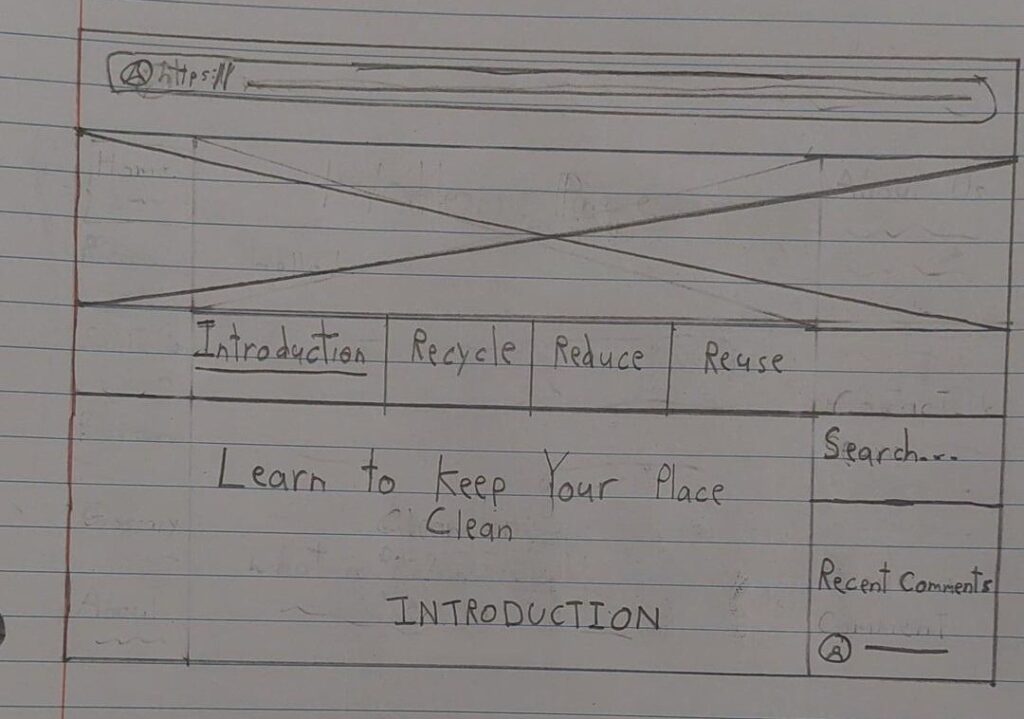
Page #1
Introduction I Recycle I Reduce I Reuse
Learn to Keep Your Place Clean
INTRODUCTION
Search…
Recent Comments
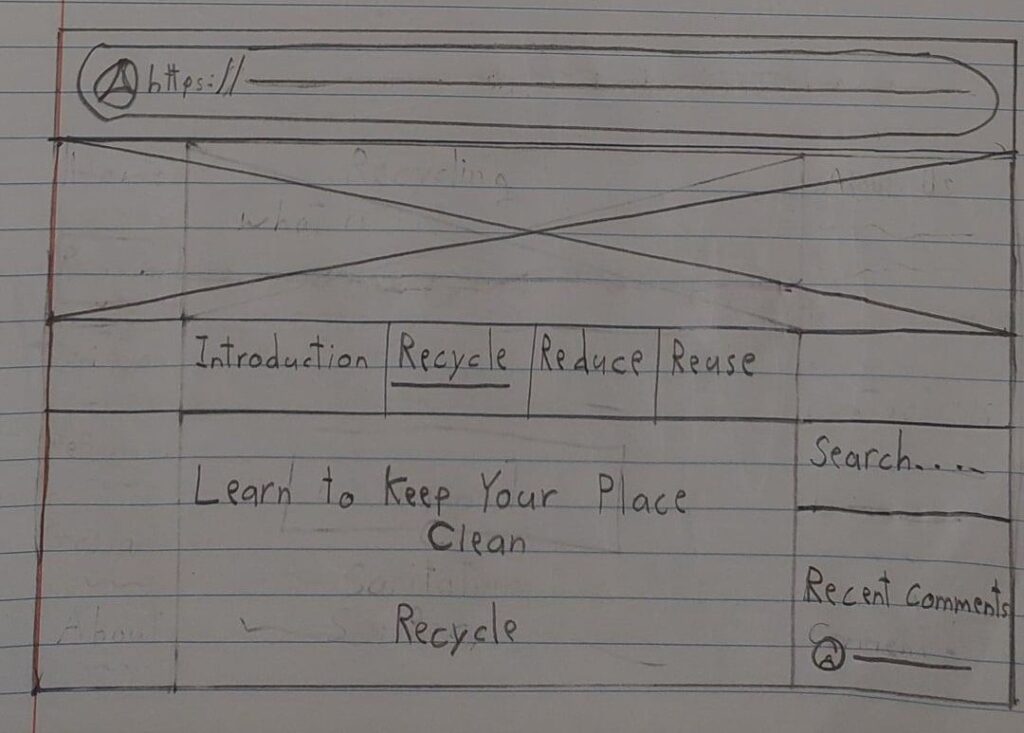
Page #2
Introduction I Recycle I Reduce I Reuse
Learn to Keep Your Place Clean
RECYCLE
Search…
Recent Comments
Scripts
Reduce
What is Reducing?
Reducing is known as the practice of generating less waste. It is the first of the three Rs of waste management: reduce, reuse, and recycle (Rogue Disposal and Recycling Inc., 2018). According to Rogue Disposal and Recycling Inc., Reducing waste is the “best method” for ensuring a clean environment. Reducing waste stops the problem early on, by creating less waste to begin with.
Reducing waste comes in many forms. It means reducing food waste by making a meal plan before buying food (Capital Regional District, 2025). It also means reducing plastic waste by purchasing items that last longer, or items that can be used multiple times (reusable water flasks as opposed to plastic water bottles).
How Reducing Works
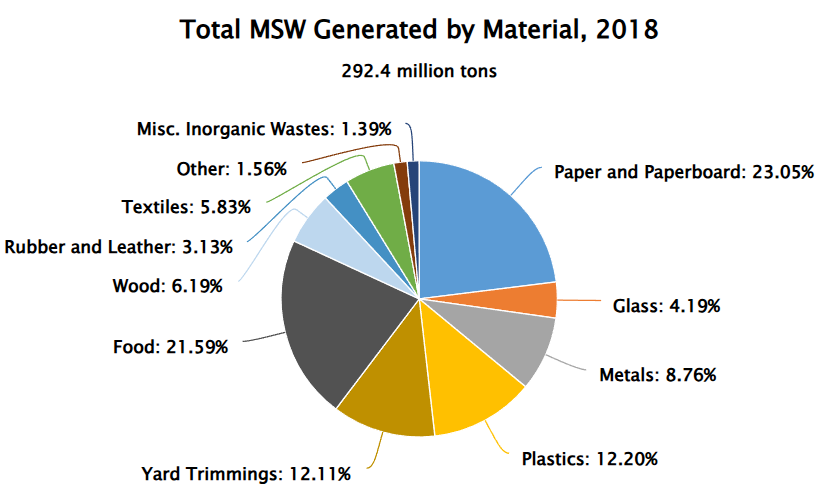
Reducing waste works by altering your habits and picking up new habits that produce less waste. Rogue Disposal and Recycling Inc. suggest some easily implementable ways for individuals to reduce waste (2018). The first one is to pack your lunch in a lunch box to reduce paper and plastic waste, which amount to roughly 35% of all Municipal Solid Waste (MSW), totalling over one third of all waste generated (U.S. Environmental Protection Agency, 2025). For reference, MSW refers to common household waste, as well as commercial or institutional waste (U.S. Environmental Protection Agency, 2025). Below is a diagram that illustrates the “Total MSW Generated by Material,” in 2018:
Why is Reducing Important?
Reducing waste is important because it makes the environment cleaner and reduces energy and resource consumption. According to the nature restoration organization Green Earth, proper waste management practices reduce air, water, and soil pollution (Green Earth, 2025). This occurs because when less waste is produced and sent to landfills and incineration facilities, less harmful substances are released into the atmosphere and environment. On the other hand, reducing the amount of waste generated reduces the energy and resources required to process it (Green Earth, 2025). This is good because it allows resources and energy to be allocated to process generated waste more efficiently.
Reuse
What Is Reusing?
Reusing is the act of using resources, materials, and products multiple times. Reusing is also the second R of waste management, and aims to reduce the amount of waste produced as much as possible (Rogue Disposal and Recycling Inc., 2018; Capital Regional District, 2025).
Reusing happens when items that would normally be thrown away are kept and used for a new or improvised purpose. For example, old clothes can be sold or donated instead of put in the trash (Rogue Disposal and Recycling Inc., 2018). Broken items like toys or electronics can be repaired so they can be used again.
How Does Reusing Work?
The more reused an item is, the more useful and the lower its footprint (Living Landscape of Reusable Solutions, 2023). For reusing to be worth it, the impact on the environment should be neutral or positive. Also, when purchasing items, purchasing reusable items or non-toxic packaging also contributes to reusing efforts. Additionally, by reusing clothes and electronics (such as ear buds) effectively, the amount of water, GreenHouse Gas (GHG), and resources used is reduced (Living Landscape of Reusable Solutions, 2023).
Why Is Reusing Important?
Reusing products is important because it strengthens the environment by reducing demand for resources and creates a sustainable lifestyle (John Tarantino, 2020). John Tarantino’s article, “How Reusing Items Can Help The Environment” gives us some reasons why reusing can help the environment. The first one is reducing demand for natural resources by reusing the products created from “environmental resources.” Additionally, reducing demand lessens pollution and decreases the energy used. Moving on, The second reason is that reusing items can help you save money . Instead of using a shirt for one day, you can use it for a lot longer. The money saved from reusing items can be used to donate to environmental charity organizations or environmentally friendly hobbies like seed planting (John Tarantino, 2020).
Recycle
What is Recycling?
Recycling is when materials are turned into new products and objects rather than being thrown away as trash (United States Environmental Protection Agency [EPA], 2025). We can collect things like paper, bottles, cans, and plastics so that these materials can be used in new ways. For example, old newspapers can be turned into new paper, and plastic bottles can be made into clothing, bags, or even park benches. Through recycling, it helps keep our environment clean and reduces waste and garbage in our landfills. Recycling also saves energy and saves materials that come from nature such as trees, water, and minerals. When we reuse what we already have, we use fewer natural resources and we help keep the planet healthy. It’s an easy way for everyone to help protect the planet.
How Does Recycling Work?
Recycling starts when you put your recyclable materials in the right bin at home or school. For example, you can place empty water bottles, milk jugs, and soda cans in the blue bin. Paper, cardboard, and magazines can also be recycled instead of being thrown away. Additionally, glass jars and clean food containers can go into the recycling bin. Sorting these items correctly helps make sure they can be turned into something new. Then, the things that you put in those recycling bins will be picked up and sent to a recycling center where they’re sorted, cleaned, and prepared (Association of Plastic Recyclers [APR], 2025). Every time you recycle, you help the Earth stay a little greener.
Why Is Recycling Important?
Recycling is important because it helps keep our planet clean and safe which reduces pollution, saves energy, and protects animals by keeping trash away from nature. Recycling also means we don’t have to use as many new materials like trees, oil, and water (Recycle BC, 2023). When we recycle paper, that means there’s fewer trees that need to be cut down. Recycling plastic reduces our need to make new plastic from oil and recycling metal saves large amounts of energy and water. This helps protect natural habitats, and saves resources for the future. Every small action makes a big difference!
Principles Applied
Mayer’s Multimedia Learning Principles
Coherence Principle
We avoided unnecessary text, images or sounds that might distract the children. Each section uses short, simple minigames, and straightforward language so it’s easy for the learners to understand the material (Désiron et al., 2025). For the minigames and quiz, we ensured that the pictures were cliparts of everyday objects that children can easily recognize and identify in order to make a personal connection in their lives. Moreover, we did not use shocking background colors and used a plain white background which prevents the learners from being distracted from reading or playing the minigames. The overall design was kept clean, consistent, and simple throughout each section of the three R’s. By incorporating these elements and combining the use of image and text, we reduced unnecessary cognitive load and helped the learners to focus on understanding the recycling concepts (de Jonge et al., 2025).
Segmenting Principle
In our website, we broke down the three R’s into their own sections in order to organize the information and prevent confusion between them for learners. Within those sections, we broke down the topics into 3 parts. These include: “What is Recycling?”, “How Does Recycling Work?”, and “Why Is Recycling Important?”. By dividing these sections, the learners can focus on one concept at a time without feeling overwhelmed thereby reducing cognitive load (Mayer et al., 2019). After the student learns these sections, the student can play short mini-games that follow the explanation provided and allow the learner to take a break between new concepts and practice what they just learned. Segmenting principle allows for the big ideas to be broken down into smaller chunks so that the learner can digest the material at a gradual pace and lets them control the pacing of the material (Ibrahim et al., 2012). By organizing the content in this way, we made learning about recycling clear and manageable for students and gave them the time they needed to absorb each idea and build a stronger understanding before moving onto the next concept.
Modality Principle
In each section and concept of recycling, we incorporated a variation of figure, diagram, video or another type of visual information to show the students the information in another way that might be easier for them to digest. When these visual diagrams are combined with text, the learner is able to process the information through both visual and verbal channels, which supports deeper learning and retention of the materials and concepts (Moreno & Mayer, 1999). For example, in the “How Does Recycling Work” section, the diagram of what items can be recycled and which recycling bin it should go into can help children process and visualize where each material should go. By seeing pictures of bottles, cans, and paper next to labeled bins, the learner can link what they see with what they read and create a clear mental model of the sorting process (Christian & Prasida, 2018). By using clear visuals and short, simple text, our website design and content allows the learners to engage with both channels without overloading either one.
Merrill’s Principles of Instruction
With alongside of applying Mayer’s principles of multimedia learning, we effectively used the Meriill’s Principles of Instruction in our website designing and creating learning activities. According to the principles of Merrill’s, effective learning happens only when learners are actively participating in solving real world problems, connecting new knowledge to prior experiences and learning new skills effectively to integrate in their daily life (Merrill, 2002). Because of our targeted audience, which is students in elementary schools, we decided to create an digital learning environment which is interactive, easy to understand and relatable. Our other focus was on reinforcing the critical thinking ,and sustainable habits learnt in the learning process about the three R’s (reuse, recycle, and reduce). Merrill’s framework guided us to design the website in a way which supports learners to move gradually from learners to taking meaningful actions.
Activation Principle
Before the learning process starts, questions like “Do you recycle at home?” or “Do you know different types of recyclables?” will be prompted to learners to activate their prior knowledge regarding the three R’s. The main importance of asking these types of questions is to allow students to recall what they already know about recycling and make themselves familiar with upcoming lessons (Merrill, 2002). This principle also helps learners to easily connect the new knowledge with the old one, making the process easier and memorable. Also, the types of products used for recycling, such as juice boxes or paper, act as visual aids that are relatable and push children to make personal connections between themselves, thecontent, and supporting engagement from the beginning.
Demonstration Principle
We also used demonstration principles to ensure that learners clearly understand the concept of recycling and how to do it. To achieve this goal, various forms of demonstration such as visual, short clips, interactive games have been incorporated in our website. For example, in the recycling section on our website it is visually and animatedly explained step by step how recycling works. These types of learning where visual and verbal both activities dual coding, making the idea or lesson more easy to learn effectively. In order to eliminate cognitive overload, we used precise information, labels and visually organized to make learners’ experience more memorable. With the help of real life examples and scenarios not just depending on texts, we made sure that learners will know what recycling is, but also why it happens which boosts comprehension.
Application principle
After learning knowledge about recycling through observations and demonstrations, learners can play mini interactive games and puzzles. For example, one of the activities is for children to drag and drop objects such as banana peel, bottles, and get these shorted into correct boxes (recycling, compost, and garbage). In this activity immediate feedback is given to every correct answer and clarifying mistakes. This type of active engagement shows the effectiveness of Merrill’s application principle, which states that connecting new knowledge with past experiences and using it in a meaningful way. This type of interactive design also allows students to complete the module on their own speed, reinforcing the engagement via play-based learning.
Peer Feedback
The feedback I received on my prototype focused on design and instructional quality. The peer noted that the website was clean, easy to navigate, and well-organized. They highlighted that the navigation bar with the sections, “Reduce, Reuse, and Recycle” demonstrated Mayer’s segmentation principle because the content was divided into smaller and manageable sections for young learners. The peer also commented that including a drag and drop sorting game aligned with Merrill’s application principle and was a creative and interactive way to reinforce the learning objectives.
The peer suggested simplifying the “Reduce” page to better suit the target audience of 5 to 12 year olds because the material might feel overcomplicated. They suggested replacing the “Total MSW General by Material, 2018” graph with a cartoon style pie chart to make the information more engaging and age appropriate for the audience. Additionally, they suggested embedding accessibility features like “click to listen” buttons directly within the site rather than relying on external Chrome extensions. Overall, the peer’s comments emphasized strong organization, showed learning principles, and demonstrated effective engagement strategies for the audience. The prototype offered practical recommendations to enhance accessibility and visual simplicity.
Another piece of feedback we received was that the navigation bar at the top was difficult to see as it disappeared when the user scrolled down. So it was recommended that the navigation bar is to stand out more.
Reflect and Refine

Team Reflection
Positives and Negatives
There are several strengths of our project and one of them is the clarity and organization of our content. We divided the website into three parts according to the three R’s – Reduce, Reuse, and Recycle, which helped us to effectively apply the segmenting principle as well as making sure that we don’t overwhelm our learners causing cognitive overload. Another strong aspect comes into the communication. Our group worked very effectively in the series of brainstorming sessions through google docs, and chats which helped us to bring the ideas to life efficiently.
We successfully managed to create an interactive learning experience integrated with various resources such as visuals, mini-games, and very simple language for accessibility reasons which aligned with Mayer’s multimedia principles and Merrill’s principles of Instructions efficiently. Everyone in our group contributed equally by creating an engaging prototype best suited for young learners.
We faced several challenges in this project mostly because we were aiming for young learners as our target audience group. One of the challenges was the imbalance of information provided in each section which could easily cause cognitive overload in our young learners. When we were drafting the project, most of the information in some sections such as the section of Reduce had too much text and complex data which violated the Coherence principle. Another challenge came in the form of accessibility. From the starting we gave importance to the diversity in our learners which is why we had to change our initial reliance on chrome extensions to built in site features to make the learner’s experience more inclusive.
Prototype Revisions
After getting the feedback from our peers and self reflection we managed to find out some weak points in our prototype and made changes accordingly. One of the changes was the simplification of the reduce section, from which we removed complex text, graphs and changed them with age appropriate charts, and easy language. Another change we made was adding more mini-games and refining visuals in order to reduce cognitive load and make the content more engaging and memorable for our young learners. We also worked on the navigation bar making it more easy to understand and navigate through. With the help of these updates we managed to strengthen our alignment with Mayer’s Coherence, Segmenting, and Modality principles.
Individual Reflection
Therese
For this project, every member made a script. I contributed on: Providing the topic, Describe the Challenge, POV statement, learning objectives, Individual and Peer Review Reflections, co-wrote Principles with Raj, dividing the work between members, and made the website and layout. Bashar contributed with: Context and Audience, Peer Feedback, Team and Individual Reflection, and visuals of the website. Raj contributed with: Ideation, Principles Applied, and Team and Individual Reflection.
Our teamwork was organized and re-distributed workload if someone was running behind. Moreover, our team met the deadlines for each section and was willing to improve the work done if needed. For future projects, we could improve by making the deadlines sooner than later. We expected this last project to be straightforward, but found out that we needed to incorporate interactive games for our content for it to be a well designed OER website, which ended up taking more time than we had hoped. However, we still made interactive games and a pop quiz along with creating the full website to receive proper feedback from our peers. Overall, our team was effective and demonstrated strong commitment, adaptability, and creativity throughout the project.
Bashar
I completed the Introduction for Phase 0. Additionally, I completed the Context and Audience sections for Phase 1. For Phase 2, I completed the storyboard and script, and assisted in making the prototype’s Reuse and Reduce sections. I also contributed to the Peer Feedback for Phase 4.
Neeraj
Our group worked together very efficiently and with better communication we managed to complete this project very effectively. we divided our work and every group member completed their work on time. I contributed in Ideation, Principles Applied, and Team and Individual Reflection, also cowrote the principles applied.
References
A greener future through waste management. (2025). Green Earth. https://www.green.earth/waste-management
Association of Plastic Recyclers. (2025). See Recycling in Action. PlasticsRecycling.org. https://plasticsrecycling.org/recycling-in-action/
Capital Regional District. (2025). Reducing Waste. https://www.crd.ca/environment/reducing-waste
Christian, I. V., & Prasida, A. S. (2018). Developing board game as learning media about waste sorting for fourth grade students of elementary school. Jurnal Prima Edukasia, 6(1), 78-88.
de Jonge, T. H., Berti, A., van Schijndel, S., van Wermeskerken, M., & Kok, E. (2025). Unraveling Coherence: The Impact of Image-Relatedness in Concept Learning. Applied Cognitive Psychology, 39(3). https://doi.org/10.1002/acp.70054
Désiron, J. C., Schmitz, M. L., & Petko, D. (2025). Teachers as Creators of Digital Multimedia Learning Materials: Are They Aligned with Multimedia Learning Principles. Technology, Knowledge and Learning, 30(2), 637–653. https://doi.org/10.1007/s10758-024-09770-1
Exploring the three Rs of waste management — Reduce, Reuse, Recycle. (2018). Rogue Disposal and Recycling Inc. https://roguedisposal.com/resources/education/recycling/exploring-the-three-rs-of-waste-management-reduce-reuse-recycle
Ibrahim, M., Antonenko, P. D., Greenwood, C. M., & Wheeler, D. (2012). Effects of Segmenting, Signalling, and Weeding on Learning from Educational Video. Learning, Media and Technology, 37(3), 220–235. https://doi.org/10.1080/17439884.2011.585993
Mayer, R. E., Wells, A., Parong, J., & Howarth, J. T. (2019). Learner Control of the Pacing of an Online Slideshow Lesson: Does Segmenting Help? Applied Cognitive Psychology, 33(5), 930–935. https://doi.org/10.1002/acp.3560
Moreno, R., & Mayer, R. E. (1999). Cognitive principles of multimedia learning: The role of modality and contiguity. Journal of Educational Psychology, 91(2), 358–368. https://doi.org/10.1037/0022-0663.91.2.358
National Overview: Facts and Figures on Materials, Wastes and Recycling. (2025). U.S. Environmental Protection Agency. https://www.epa.gov/facts-and-figures-about-materials-waste-and-recycling/national-overview-facts-and-figures-materials
Recycle BC. (2023). The importance of sorting. https://recyclebc.ca/the-importance-of-sorting/United States Environmental Protection Agency. (2025). Recycling Basics and Benefits. https://www.epa.gov/recycle/recycling-basics-and-benefits